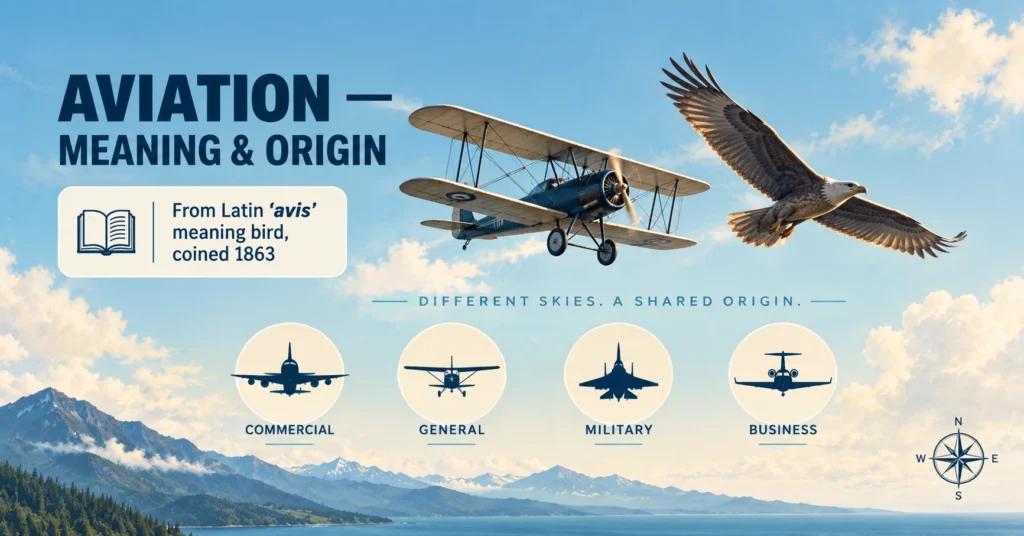
People throw the word “aviation” around constantly, whether they’re talking about airport jobs, airline news, or a hobbyist building model planes in the garage, but the actual aviation meaning is a bit broader and more specific at the same time than most casual usage suggests. This article breaks down the full aviation meaning, where the word came from, and how its different branches fit together.
The Straightforward Aviation Meaning
At its core, the aviation meaning refers to the operation of aircraft, along with the broader industry built around designing, manufacturing, and flying them. Merriam-Webster defines it specifically as the operation of aircraft, sometimes narrowed further to heavier-than-air aircraft, which distinguishes it from lighter-than-air technology like balloons and airships in more technical usage. In everyday conversation, though, the term stretches to cover nearly anything connected to flight: pilots, air traffic control, aircraft manufacturing, airport operations, and the regulatory bodies that oversee all of it.
| Term | What It Refers To |
|---|---|
| Aviation | The operation of aircraft and the surrounding industry |
| Aeronautics | The science of designing and building aircraft |
| Aircraft | Any device used or intended for flight in the air |
| Aviator | A person who operates or pilots an aircraft |
Where the Word Comes From
The aviation meaning we use today traces back to a genuinely specific origin point rather than evolving gradually over centuries the way a lot of English words do. French aviation pioneer Gabriel de La Landelle coined the term in 1863, building it from the Latin word “avis,” meaning “bird.” The choice makes sense on its face, since early efforts at powered flight were directly inspired by watching how birds achieved lift and control in the air. The word entered English usage by 1866, and the connection to “avis” runs deeper than most people realize, sharing roots with words like “aviary,” “avian,” and even “egg,” through the same Proto-Indo-European root referring to birds.
The Different Branches Covered Under the Aviation Meaning
Because the aviation meaning is broad by design, it’s often useful to break it down into the major categories people actually mean when they use the word.
| Category | What It Includes |
|---|---|
| Commercial Aviation | Scheduled passenger and cargo airline operations |
| General Aviation | Private pilots, small aircraft, flight training, non-commercial flying |
| Military Aviation | Air forces, military aircraft, and defense-related flight operations |
| Business Aviation | Corporate jets and private charter flights for business travel |
Each of these branches operates under different regulatory frameworks in most countries, but all of them fall comfortably under the same umbrella term.
Aviation Meaning Versus Aeronautics: A Common Mix-Up
These two terms get confused constantly, and while they’re related, they’re not actually interchangeable. Aeronautics refers specifically to the science and engineering behind designing and building aircraft, while the aviation meaning centers more on the actual operation of those aircraft once they exist. Put simply, aeronautics is closer to the “how it’s built” side of things, and aviation covers the “how it’s flown and operated” side, including everything from pilot training to airline scheduling to airport ground operations.
Why This Word Matters Beyond the Dictionary
Understanding the aviation meaning matters for more than just vocabulary trivia. The term shows up constantly in job postings, news coverage, and travel contexts, and knowing the full aviation meaning helps make sense of what you’re reading. A “career in aviation” could mean anything from piloting commercial jets to working in airport security to designing aircraft engines, since the word deliberately spans such a wide range of roles and industries rather than pointing to one narrow job description.
| Where You’ll See It Used | What It’s Referring To |
|---|---|
| Job listings (“aviation career”) | Any role connected to aircraft operation or the airline industry |
| News headlines (“aviation industry”) | The broader business sector around airlines and aircraft |
| Safety reports (“aviation safety”) | Standards and practices governing flight operations |
| School programs (“aviation degree”) | Academic training in piloting, aircraft maintenance, or airport management |
A Quick Note on the Cocktail
If you’ve ever seen “Aviation” listed on a cocktail menu, that’s a real, if less common, secondary use of the aviation meaning worth mentioning. The Aviation cocktail, made with gin, maraschino liqueur, crème de violette, and lemon juice, dates back roughly to the same early-20th-century period when powered flight was capturing public imagination, and its pale, sky-like color is widely assumed to be a nod to the same aviation meaning that inspired its name.
Common Questions About the Aviation Meaning
The operation of aircraft, along with the broader industry built around designing, building, and flying them. Most dictionaries frame it this way before expanding into more specific technical distinctions.
It was coined in 1863 by French aviation pioneer Gabriel de La Landelle, derived from the Latin word “avis,” meaning “bird,” reflecting how early flight experiments were directly inspired by observing birds.
Not quite. Aeronautics refers to the science and engineering of designing and building aircraft, while the aviation meaning centers more on operating aircraft once they exist, including piloting, air traffic control, and airline operations.
Yes. The term covers all types of aircraft, including helicopters, drones, gliders, and airships, not just fixed-wing airplanes, since the underlying definition centers on operating any device intended for flight.
The major categories are commercial aviation, general aviation, military aviation, and business aviation, each covering a different segment of who’s flying and why.