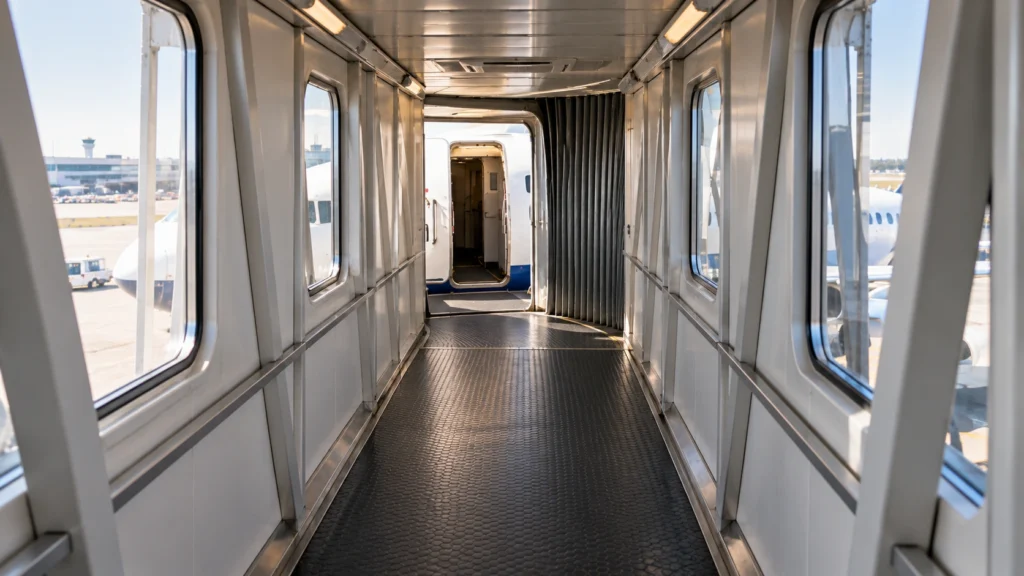
You’ve used one dozens of times without ever learning its name. That enclosed tunnel you walk through to get from the gate onto the plane — no rain, no wind, no staring down at the tarmac — is a jet bridge. Officially it’s called a passenger boarding bridge. Nobody actually calls it that.
Picture a big accordion tube on wheels. One end is bolted to the terminal at a spot called the rotunda (sometimes people say “pivot”). The other end — the cabin — reaches out and finds the plane’s door. Whatever’s in between stretches or shrinks depending on how far the aircraft parked from the gate.
Here’s the thing people usually get wrong about a jet bridge: it doesn’t latch onto the plane. No clamps, no seal. The cabin just sits up against the door frame, and a flexible rubber-ish canopy keeps rain and wind out. That’s it. Which is exactly why an aircraft can never move an inch while a jet bridge is docked against it — there’s nothing physically holding the two together besides careful positioning.
| Detail | Information | Good to Know |
|---|---|---|
| Official name | Passenger boarding bridge (PBB) | “Jet bridge” is the common everyday term |
| Fixed end | Rotunda or pivot, attached to the terminal | Allows the bridge to swing left or right |
| Movable end | Cabin, meets the aircraft door | Adjusts height, extension, and angle |
| Connection type | Positioned against the door sill | Not mechanically locked to the aircraft |
Getting It to Line Up
Watching a jet bridge dock is more fiddly than you’d think from inside the terminal. Someone’s operating it — extending, rotating, raising or dropping the cabin — while the plane is still finishing its taxi in. And the aircraft doesn’t sit still once it’s parked, either. As bags and fuel and passengers move on and off, its height shifts, sometimes by a few inches. A good jet bridge has sensors that catch this and nudge the platform to match, so nobody ends up stepping over a gap or into a wall.
If the alignment’s off, bad things happen fast — a scraped fuselage, a jammed door, a dented bridge. So there’s a stack of safety gear built in: limit switches, emergency stops, bumpers. Before the plane pushes back, the jet bridge retracts well out of the way. Leave it too close and you risk clipping a wing on the way out, which is not a conversation anyone wants to have with the flight crew.
| Step | What Happens | Why It Matters |
|---|---|---|
| Extension | Bridge extends toward the parked aircraft | Bridges the gap between gate and door |
| Height adjustment | Cabin raises or lowers to match the door | Aircraft height varies by model and load |
| Docking | Platform positions against the door sill | No mechanical lock; alignment must stay precise |
| Retraction | Bridge pulls back before departure | Clears space for the aircraft to push back safely |
Where It Came From
Before jet bridges existed, boarding meant walking out onto open tarmac and climbing portable stairs, rain or shine, hoping a fuel truck wasn’t rolling past at the wrong moment. As airports got busier through the 1950s, that started to feel less charming and more dangerous — too many planes, too many vehicles, too many people crossing the same stretch of concrete.
United Airlines took a swing at fixing it, testing something called the “Air Dock” around 1954. A more refined jet bridge showed up at Chicago’s O’Hare Airport in 1958 — which is why O’Hare tends to get named as the home of the first jet bridge, at least in its recognizably modern form.
The design has barely changed since. A 1958 jet bridge and a 2026 jet bridge solve the same problem the same basic way: pivot, extend, dock, retract. A few airports got clever with the jet bridge concept — Melbourne Airport in Australia runs its bridges with a center pivot so one structure can reach two different gates.
Why Some Planes Skip It Entirely
Plenty of flights never touch a jet bridge. Smaller regional airports, budget carriers watching every dollar, overflow parking during a busy afternoon — all of these commonly send passengers down a set of mobile stairs instead. When gates run short, ground crews just have to decide who gets the bridge and who gets the stairs and a walk across the apron.
Private jets and cargo planes skip the jet bridge too, usually because the door doesn’t match up with a standard one, or because the airport never bothered building bridge infrastructure for aircraft that size in the first place. For a passenger, that mostly just means a short, slightly inconvenient walk in whatever weather happens to be going on that day.
| Situation | Why No Jet Bridge | What Happens Instead |
|---|---|---|
| Regional or smaller airports | Bridge infrastructure often isn’t built out | Mobile stairs bring passengers to the aircraft door |
| Budget carriers | Avoiding gate and bridge-related fees | Boarding from the tarmac via stairs |
| Remote or overflow parking | Limited number of gates with bridges | Aircraft parked at a hard stand, reached by bus or on foot |
| Private and cargo aircraft | Door design often incompatible | Stairs or a lift, rather than a jet bridge |
The Part Passengers Never See
A jet bridge changes more than the boarding experience — it shapes the whole gate around it. Ground crews load fuel, catering, and baggage from a specific side of the plane, every time, as a matter of routine. That means the jet bridge has to sit somewhere that doesn’t block a fuel truck or a baggage cart trying to get in during a fifty-minute turnaround. Get the layout wrong and you’ve built yourself a very expensive traffic jam.
Some busier hubs go further with split jet bridges: one rotunda, two separate cabins, connecting to two planes parked nose to nose at the same gate. It’s a space trick that only really pays off when apron space is scarce enough to fight over.
Keeping One Running
A jet bridge isn’t something you install and forget about. Airports run the jet bridge through regular inspections — hydraulics, wiring, the works — because one broken bridge can freeze an entire gate until it’s fixed or someone drags mobile stairs over as a stopgap. Neither option is fast, and both slow down boarding noticeably compared to a bridge working the way it’s supposed to.
Weather doesn’t help. Even with the canopy, a jet bridge sits partly exposed, and the wheel assembly on the aircraft end takes a real beating over years of rain, snow, and temperature swings. Airports in rougher climates tend to spend more on upkeep, for good reason — a bridge frozen halfway through extension during a snowstorm is exactly the kind of gate-blocking mess the whole thing exists to prevent.
Why It’s Not at Every Gate
A single jet bridge isn’t cheap. Once you count installation and the surrounding gate work, the bill can run into six figures without much trouble. That’s a big part of why smaller airports and no-frills airlines skip the jet bridge and stick with stairs — building bridge infrastructure at every gate is a serious capital outlay, and it only makes sense once passenger volume is high enough to justify it.
Big hub airports eat that cost more easily, since a jet bridge speeds up boarding, cuts weather delays, and keeps travelers moving through shops and security instead of standing around on wet tarmac. A regional airport running a handful of flights a day just doesn’t get the same return on the investment.
F&Q
A jet bridge, officially called a passenger boarding bridge, is a movable enclosed walkway connecting an airport terminal gate directly to an aircraft door. That’s the short version of the jet bridge meaning — the mechanics behind it are a bit more involved.
No. It positions its platform against the door sill and relies on a flexible canopy to block weather, but there’s no mechanical clamp or lock connecting it to the plane.
United Airlines tested an early design called the “Air Dock” around 1954, with a more developed version appearing at Chicago’s O’Hare Airport in 1958.
Chicago’s O’Hare Airport generally gets credit as the home of the first jet bridge in its modern form, dating to 1958, following United Airlines’ earlier “Air Dock” concept from 1954.
Smaller airports, budget carriers, remote parking stands, and aircraft with incompatible doors — like many private and cargo planes — often rely on mobile stairs instead.
Officially, it’s a passenger boarding bridge. “Jet bridge” is just the everyday name most people default to.
None, really. Jetway, jetbridge (one word), air bridge, aerobridge, passenger boarding bridge — all the same structure, different names depending on who’s talking.
Next time you’re walking through one, take a second to notice it. It’s built to be forgotten — solving a genuinely awkward problem of getting people from a terminal onto a plane without weather, ground traffic, or a rickety staircase in the way — and it does that job quietly enough that almost nobody thinks about how it actually docks, adjusts, or knows exactly when to pull back before a flight rolls away from the gate.