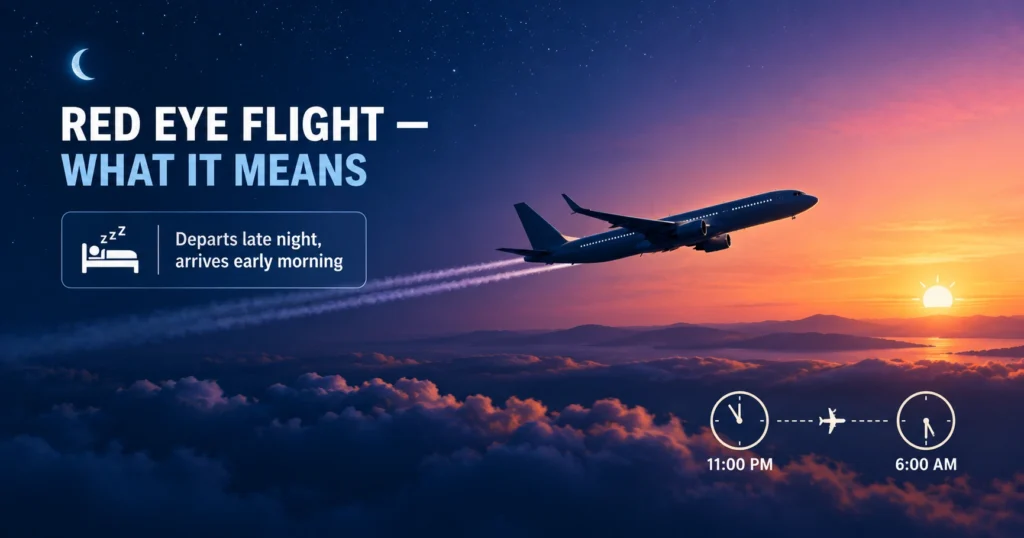
Anyone who’s landed groggy after an overnight flight, blinking under airport lights with eyes that clearly haven’t slept, already understands the red eye flight meaning even before they know where the phrase comes from. It’s one of those aviation terms that’s exactly as literal as it sounds.
The red eye flight meaning traces directly back to what happens to passengers physically. These flights depart late at night, typically after 10 p.m., and arrive early the following morning, leaving little to no real window for proper sleep. The disrupted rest leaves travelers with bloodshot, irritated eyes by the time they land, and the name stuck as an obvious, informal way to describe the experience rather than any official aviation terminology.
| Element | Typical Detail |
|---|---|
| Departure Window | Generally 9 p.m. to midnight |
| Arrival Window | Early morning, often before 8 a.m. |
| Origin of the Term | Bloodshot eyes from disrupted overnight sleep |
| Official Industry Term? | No, it’s informal usage rather than a regulatory definition |
The Actual Red Eye Flight Meaning in Practice
There’s no single official cutoff that determines whether a flight qualifies for the red eye flight meaning, but the general pattern is consistent across sources: it’s an overnight flight that crosses midnight and is long enough to disrupt a full night’s sleep rather than just a short evening hop. A one-hour flight departing at 11 p.m. wouldn’t typically earn the label, while a five- or six-hour overnight route almost always would, since the duration genuinely interferes with getting proper rest.
Why Airlines Actually Schedule Them
There’s a solid business logic behind red eye flights beyond just squeezing extra departures into a schedule. Aircraft sitting idle overnight generate zero revenue, so airlines use these hours to keep planes flying rather than parked at a gate. Airports benefit too, since shifting some passenger volume to overnight hours reduces pressure on daytime capacity, which matters enormously at busy hubs where daytime landing and takeoff slots are already scarce and expensive.
| Reason | Who Benefits |
|---|---|
| Aircraft utilization | Airlines avoid idle overnight downtime |
| Reduced daytime congestion | Airports and air traffic control |
| Lower fares | Passengers, due to lower demand for these time slots |
| Full-day scheduling | Business travelers preserving working hours on both ends |
The Trade-Offs Behind the Red Eye Flight Meaning
Cheaper fares are the most obvious upside tied to the red eye flight meaning, since airlines price these seats lower to fill demand during off-peak hours. Business travelers in particular use overnight flights specifically to protect a full working day at both the origin and destination, essentially “earning” an extra day by sleeping through the travel time instead of losing daylight hours to it. The downside is just as real: in-flight service is often reduced, meals and entertainment can be limited, and arriving several hours before a hotel check-in window is a common headache that catches first-time red-eye travelers off guard.
| Pros | Cons |
|---|---|
| Generally cheaper fares | Difficult to get quality sleep on board |
| Preserves a full day at both ends of the trip | Reduced in-flight service on many routes |
| Less crowded, quieter airports | May arrive too early for hotel check-in |
| Good for business travelers with tight schedules | Limited meal and entertainment options |
The Corporate “Red-Eye Rule”
A newer development worth knowing about is the emergence of formal workplace policies addressing red eye flight fatigue directly. Some corporate travel programs now include a “red-eye rule,” requiring employees to get a defined recovery window, commonly somewhere between 12 and 24 hours, before attending client meetings or high-stakes negotiations after landing from an overnight flight. Common triggers for this kind of policy include crossing more than three time zones, landing before 8 a.m. local time, or completing a flight of six or more hours without a business-class seat. This reflects a growing recognition that sleep-deprived decision-making genuinely affects professional performance, not just personal comfort.
Regional Differences Worth Knowing
The frequency of red eye flights isn’t evenly distributed around the world. They’re more common on long routes outside North America, Europe, and Australia, partly because airport curfews tend to be stricter across those regions, limiting how many overnight departures and arrivals are even permitted. Within the United States, red eye flights are especially common on coast-to-coast routes, where the multi-hour time difference makes an overnight option genuinely practical rather than just a scheduling quirk.
Tips for Surviving One
A comfortable neck pillow and noise-canceling headphones make a bigger difference on a red eye than most first-timers expect, given how much ambient cabin noise interferes with actual sleep. Avoiding caffeine and heavy meals in the hours before boarding helps your body settle into something closer to a normal sleep pattern once you’re airborne. Booking an aisle seat if you tend to get up during flights, or a window seat if you want something to lean against, is worth deciding in advance rather than accepting whatever’s left at check-in.
Common Questions About the Red Eye Flight Meaning
What is the actual red eye flight meaning? The red eye flight meaning refers to an overnight flight that departs late at night, generally after 9 or 10 p.m., and arrives early the next morning, named for the bloodshot, tired eyes passengers commonly have after disrupted sleep during the trip.
Are red eye flights actually cheaper? Often, yes, though not universally. Prices depend on route demand, season, and competition, but lower demand during overnight hours frequently translates into lower fares compared to equivalent daytime departures.
Is there an official cutoff time that defines a red eye flight? No official industry standard exists. It’s generally understood as an overnight flight long enough to disrupt a full night’s sleep, rather than being tied to one specific duration or departure time.
Why do airlines run red eye flights at all? Mainly to keep aircraft generating revenue during hours they’d otherwise sit idle at a gate, while also easing pressure on daytime airport capacity at busy hubs.
Do red eye flights affect job performance the next day? Potentially, yes. This concern has led some companies to adopt formal recovery-window policies requiring employees to rest before high-stakes meetings following an overnight flight.