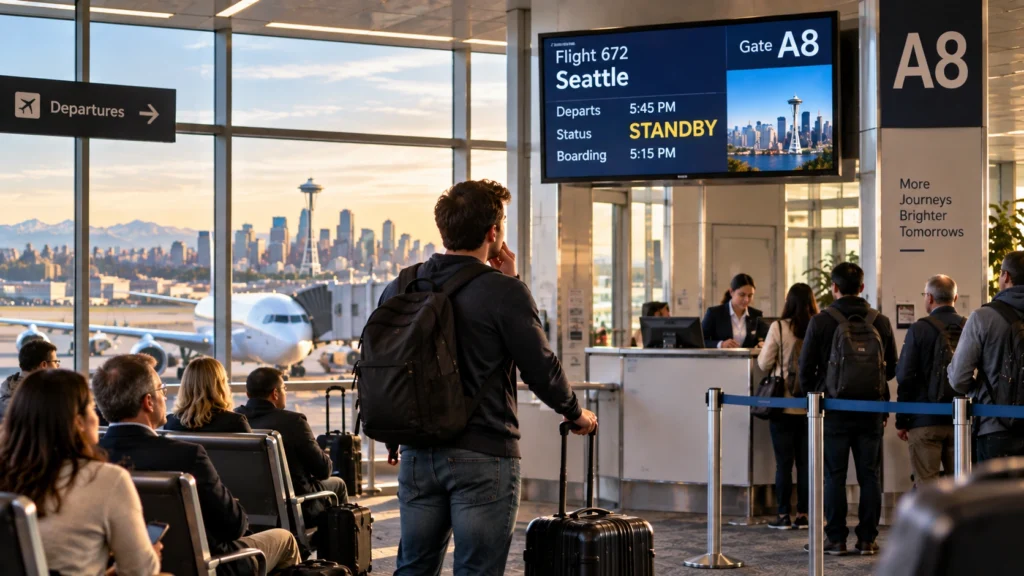
Ask ten people what “flying standby” means and half of them will describe something out of the 1990s — showing up at the airport with a bag and a hope, buying a cheap last-minute seat if one exists. That version is mostly gone. A standby flight today is a request to swap onto a different flight than the one you already booked, and it only comes through if a seat happens to open up right before boarding. Simple in theory. Less simple once you factor in eligibility, fees, and the fact that airlines have gotten very good at not leaving empty seats a standby flight depends on.
What a Standby Flight Actually Means
Here’s the basic mechanic: you hold a ticket for one flight, but you’d rather take a different one — usually earlier, sometimes later, same day. You ask to go on the standby flight list for that other departure. If a seat frees up before boarding closes, whether from an unsold seat or someone who simply didn’t show, standby passengers get called forward in priority order. No seat frees up for the standby flight? You board your original flight like nothing happened.
That’s the part people forget going in: a standby flight request doesn’t come with any promise attached. Airlines fill flights close to capacity now, which means the pool of leftover seats a standby flight depends on has shrunk a lot compared to a decade or two ago.
| Detail | Information | Good to Know |
|---|---|---|
| What it requires | An existing ticket for a flight that day | You generally can’t fly standby without an existing booking |
| What it depends on | An empty seat or no-show at boarding | Never guaranteed, even with high priority |
| Typical use case | Switching to an earlier or later flight same day | Also used when your original flight is disrupted |
Voluntary vs Involuntary Standby
Not all standby flight situations are the same, and the difference actually changes what it costs you. A voluntary standby flight is one you ask for on your own — you’d rather leave earlier, or you want to grab a later flight for some reason of your own. An involuntary standby flight is the opposite: something happened that wasn’t your fault. A missed connection. A cancelled flight. Getting bumped off an oversold one.
Airlines tend to treat these standby flight situations differently, and reasonably so. If they caused the disruption, putting you on a standby flight for the next available departure usually doesn’t cost anything extra. Ask for a voluntary standby flight purely for your own convenience, though, and there’s a decent chance a same-day change fee shows up, unless your fare or loyalty tier gets you out of it.
| Type | When It Happens | Typical Cost |
|---|---|---|
| Voluntary standby | You choose to switch flights for convenience | Often comes with a same-day change fee |
| Involuntary standby | Missed connection, cancellation, or oversold flight | Usually free, since it’s the airline’s responsibility |
Why You Can’t Just Show Up and Fly Standby Anymore
If you’re picturing the old standby flight ticket — walk up, no reservation, grab whatever’s cheap and open — that mostly ended after security tightened up in the years after 2001. Airports and airlines pushed toward requiring a ticket before you even reach a gate, in most cases, which quietly killed off the walk-up standby flight era.
Airlines also got smarter about filling seats in advance. Booking algorithms now squeeze nearly every seat full before departure, so the leftover inventory that used to make cheap standby flight travel possible just isn’t there the way it once was. A standby flight now is almost always about moving between two flights you already have a legitimate claim to — not a workaround for skipping the planning stage entirely.
Who Can Fly Standby
A few groups tend to have real standby flight access, though it varies by airline and by fare. If you already hold a same-day ticket, you can usually ask for a standby flight onto an earlier or later departure — your odds improve if you’ve got elite status or a higher fare class. Airline staff and their eligible family members have used the standby flight system for decades as a job perk, flying at a steep discount when there’s room, something insiders call flying “non-rev.”
Basic economy tends to get left out of free same-day standby flight options, since airlines generally save that flexibility for pricier fares or loyalty members. If your ticket is basic economy, check your airline’s actual standby flight rules before assuming you’re covered.
| Traveler Type | Standby Access | Good to Know |
|---|---|---|
| Passengers with existing tickets | Same-day standby to a different flight | Often free with elite status, fee-based otherwise |
| Airline employees and eligible family | Steeply discounted “non-rev” travel | A long-standing employee travel perk |
| Basic economy ticket holders | Frequently excluded from free standby | Check your specific fare rules before counting on it |
| Low-cost carrier passengers | Often unavailable entirely | Airlines like Ryanair and easyJet generally don’t offer standby |
How Much Does a Standby Flight Cost
The price tag on a standby flight, if there is one, comes down to your airline, your fare class, and whatever status you’ve got. Elite frequent flyers often fly standby for nothing at all. Everyone else is usually looking at a standby flight fee, commonly around $75 on the major US carriers, according to industry sources — not far off from a typical flight change fee. First and business class seats tend to skip that charge too, which fits the broader pattern of airlines being more generous with their highest-spending customers.
When the standby flight situation is involuntary — your flight got cancelled or delayed and the airline’s putting you on the next one — that’s typically handled free of charge, since the disruption wasn’t on you. Still worth double-checking your standby flight fee with the gate agent, since policies shift and don’t always get announced loudly.
How to Get on a Standby List
There are a handful of ways to get on a standby flight list: the airline’s app, the gate agent standing right there, the check-in counter, or the “manage booking” section on the website. Whatever route you pick, speed matters — a standby flight list runs on priority order, so getting your name down early beats waiting around.
If you’re dealing with an involuntary situation, a missed connection or a sudden cancellation, working more than one channel at once tends to move faster than standing in a single line hoping. Talk to the gate agent while you’re also pulling up the app.
| Step | How to Do It | Good to Know |
|---|---|---|
| Check eligibility | Review your fare type and loyalty status | Basic economy often doesn’t qualify for free standby |
| Request standby | Via the airline app, gate agent, or check-in counter | Acting early improves your position on the list |
| Confirm fees | Ask directly whether a same-day change fee applies | Involuntary standby is usually free |
| Wait for boarding | Standby passengers are called if seats open up | No guarantee a seat becomes available |
Pros and Cons of Flying Standby
When it works out, a standby flight is genuinely convenient. Grabbing an earlier flight buys you extra hours at your destination, and skipping a formal rebooking fee can make it cheaper than officially changing your ticket. If you’ve got a tight connection coming up, jumping on an earlier flight can also give you breathing room before the next leg.
When it doesn’t work out, though, the downsides of a standby flight are just as real. There’s no guarantee, full stop — you might spend an hour hovering near the gate only to end up on your original flight anyway. Groups have it worse, since a standby flight list rarely hands out seats together, even when individual seats do open up. Long waits happen. Occasionally, if nothing ever frees up, so does an unplanned night at the airport hotel.
| Pros | Cons |
|---|---|
| Chance to catch an earlier flight | No guarantee of a seat |
| Can help with a tight connection | Long waits are common |
| Sometimes cheaper than a formal rebooking fee | Groups may not get seats together |
| Often free during airline-caused disruptions | Basic economy fares frequently excluded |
Frequently Asked Questions
A standby flight is a request to fly on a different flight than the one you booked, filled only if an empty seat or a no-show opens up before boarding.
No. Since security requirements tightened after 2001, you generally need an existing ticket for that day’s travel before you can request standby.
It depends. Voluntary standby often comes with a same-day change fee, commonly around $75, while involuntary standby caused by a cancellation or missed connection is usually free.
Yes. Airline employees and their eligible family members have long used standby flight travel, sometimes called “non-rev” flying, as a steeply discounted travel perk.
No. Full-service carriers like Delta, United, and Lufthansa typically offer standby options, while many low-cost carriers, including Ryanair and easyJet, generally don’t offer a standby flight option at all.
None of this makes a standby flight a bad option — it just means going in with realistic expectations. Know whether your situation is voluntary or involuntary, check what your fare actually allows, and get your name on the list early. Do that, and standby can genuinely work in your favor. Just remember what you’re actually betting on: a seat that might show up, not one that’s promised to you.