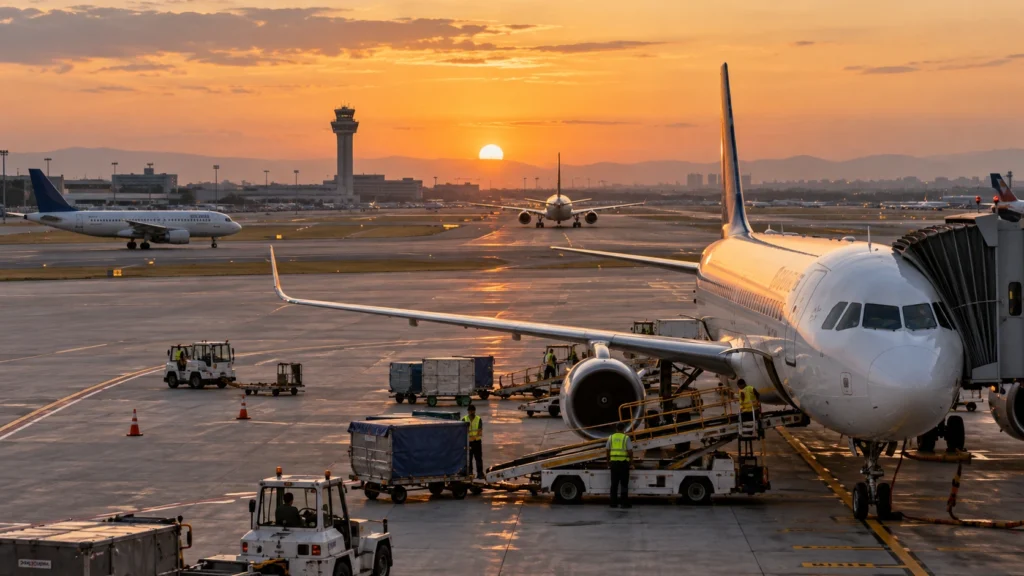
Every time a flight sits waiting for takeoff, someone on board says it: “we’re stuck on the tarmac.” Everyone knows roughly what that means. Fewer people know the word tarmac is actually a bit of a misnomer — one that even aviation folks quietly roll their eyes at.
So What Does Tarmac Actually Mean?
Tarmac, at its core, is a paving material. Short for “tarmacadam,” it’s a mix of tar and crushed stone, patented by a British company back around 1901 and 1902, based on a road-surfacing method an engineer named John McAdam came up with in the 1800s. That’s the literal, original meaning — a type of surface, not a place.
Somewhere along the way, though, the word tarmac drifted. People started using “tarmac” to describe any paved area of an airport where planes move around — runways, taxiways, the parking areas near gates. Doesn’t matter what the surface is actually made of anymore. Most modern airports use asphalt concrete these days, not real tarmacadam, but “tarmac” stuck as the catch-all term anyway.
| Detail | Information | Good to Know |
|---|---|---|
| Literal meaning | A tar-and-crushed-stone paving material | Patented around 1901–1902 |
| Common usage today | Any paved airport surface — runway, taxiway, apron | Regardless of actual material used |
| Aviation industry preference | “Ramp” or “apron” | Considered more technically accurate |
| Word origin | Short for “tarmacadam” | Named after engineer John McAdam’s technique |
Why Pilots and Airport Staff Cringe a Little
Ask someone who actually works at an airport, and there’s a decent chance they’ll tell you tarmac isn’t really the right word at all. Officially, ground crews call the space where planes park, undergo servicing, board passengers, and taxi around the ramp or the apron. Runways are runways. Taxiways connect everything together. None of those official terms have much to do with the tar-based product tarmac originally named.
One airport even put it plainly on their own blog: calling the paved area where planes park “the tarmac” is a bit like calling a parking lot “the concrete” instead of, well, the parking lot. It’s descriptive of a material, not a proper name for the space. Reporters and the general public never got that memo, though, and at this point “tarmac” has basically won the popularity contest regardless of what industry professionals prefer.
Ramp vs. Apron vs. Taxiway vs. Runway
If tarmac is the informal catch-all, it helps to know what it’s actually standing in for. The apron (also called the ramp, or loosely, the tarmac) is where ground crews park, load, refuel, and unload aircraft, and where passengers board. Taxiways are the connector paths between the apron, the gates, and the runway — think of them as the roads an aircraft drives on to get where it’s going. The runway itself is the strip built specifically for takeoff and landing, and it’s the one area that almost never used actual tarmacadam as a material, even historically.
| Term | What It Actually Means |
|---|---|
| Apron / Ramp | Where aircraft park, load, refuel, and board passengers |
| Taxiway | Paths connecting the apron, gates, and runway |
| Runway | The strip built for takeoff and landing |
| Tarmac (colloquial) | Informal catch-all for any of the above |
What “Stuck on the Tarmac” Actually Refers To
When a flight’s delayed and passengers hear “we’re on the tarmac,” that usually means the plane’s sitting somewhere on airport pavement — maybe waiting for a gate, maybe queued for takeoff, maybe held after landing — without access to the terminal. That tarmac situation matters enough that regulators actually built rules around it.
In the US, airlines can’t leave a plane sitting on the pavement indefinitely without giving passengers a chance to get off. The rule, in place since 2010, sets the limit at 3 hours for domestic flights and 4 hours for international ones, with food and water required within the first 2 hours of any delay. The rule came after a string of incidents where passengers got stuck for hours with no real end in sight — one especially bad case in Rochester, Minnesota left dozens of people on a plane overnight and led directly to the regulation existing today.
| Rule Detail | Requirement |
|---|---|
| Domestic flight limit | 3 hours before passengers must get the option to deplane |
| International flight limit | 4 hours before passengers must get the option to deplane |
| Food and water | Required within 2 hours of the delay starting |
| Exceptions | Safety, security, or air traffic control disruptions |
Airlines that break the rule face real penalties — fines that can run into the tens of thousands of dollars per passenger, which adds up fast on a full flight.
What Color Is Tarmac, Anyway?
Actual tarmacadam is dark gray to black, thanks to the tar binder holding the crushed stone together. Modern asphalt concrete, which is what most runways and ramps are actually paved with today, looks pretty much the same to the eye — that same dark, almost charcoal color that absorbs heat and shows tire marks after enough traffic rolls over it.
Where the Word Actually Came From
Long before airplanes existed, tarmac was solving a completely different problem: muddy, rutted roads. John McAdam developed a technique in the early 1800s using layers of crushed stone to build a durable road surface, and that method became known as “macadam” roads. Later, someone had the idea to bind the crushed stone together with tar instead of just compacting it, and people shortened that combination — tar plus macadam — into “tarmac.” A British company patented the specific process around 1901, and it spread quickly as a road-building standard.
Airports came along later and needed exactly the same paved surface roads did: a hard, durable surface that could handle heavy, repeated loads without breaking down. Tarmac made sense as an early paving choice for runways and parking areas, and the name carried over even after asphalt concrete largely replaced the original tar-and-stone mixture in most modern construction. That’s really the whole story behind why a 19th-century road material called tarmac ended up as slang for where airplanes sit today.
Why News Reports Love the Word
Turn on any news segment about a flight delay and there’s a good chance tarmac shows up within the first sentence. Part of that’s just habit — journalists picked up the term decades ago and it stuck as shorthand, the same way most people say “concrete” or “pavement” without thinking about the specific material underneath their feet. Part of it’s also that “tarmac” simply sounds more evocative than “apron” or “ramp” for a dramatic delay story, even if it’s not the technically precise word.
That gap between everyday usage and industry preference isn’t unique to aviation, either. Plenty of words drift from a specific technical meaning into a broader, looser one once enough people use them that way long enough. Tarmac is just a particularly clear example, since the industry itself keeps a fairly firm line between what it calls things internally and what ends up in a headline.
What to Actually Do During a Tarmac Delay
If your flight ends up stuck on the tarmac for a while, there’s not a whole lot you can control, but a few things genuinely help. Keep your phone charged before boarding, since you’ll want battery life for checking updates or rebooking if things drag on. Pack a snack and something to drink in your carry-on rather than counting entirely on the airline, especially since food and water requirements only kick in after the delay hits the two-hour mark.
Ask a flight attendant directly if you’re unsure how long the delay’s expected to run — crews usually get updates from the cockpit periodically, even if nothing’s announced over the intercom right away. And if the delay does stretch past the legal limit and you’re offered the chance to get off the plane, know that leaving doesn’t guarantee you a seat back on if the flight eventually departs, so weigh that tradeoff before deciding.
Frequently Asked Questions
It’s the everyday term for any paved area where aircraft move — runways, taxiways, and the parking apron — even though the aviation industry technically prefers “ramp” or “apron” for that space.
Not officially. “Tarmac” is technically the name of a paving material, not a place. Airport professionals generally use “ramp” or “apron” instead.
Dark gray to black, due to the tar or asphalt binder used in the material. Most modern airport surfaces share that same dark coloring even though they’re usually asphalt concrete rather than true tarmacadam.
US regulations require airlines to offer passengers the chance to deplane after 3 hours for domestic flights and 4 hours for international ones, with exceptions for safety, security, or air traffic control issues.
Because the word stuck. Once “tarmac” became shorthand in news reports and everyday conversation, it outlasted the industry’s preference for more precise terms like ramp or apron.
At the end of the day, “tarmac” isn’t going anywhere. It’s baked into how people talk about airports, even if the word technically refers to a paving material rather than an actual place. Next time you hear “we’re waiting on the tarmac,” you’ll at least know you’re standing on a bit of linguistic history — and that somewhere, an airport employee is quietly thinking “that’s actually the apron.”