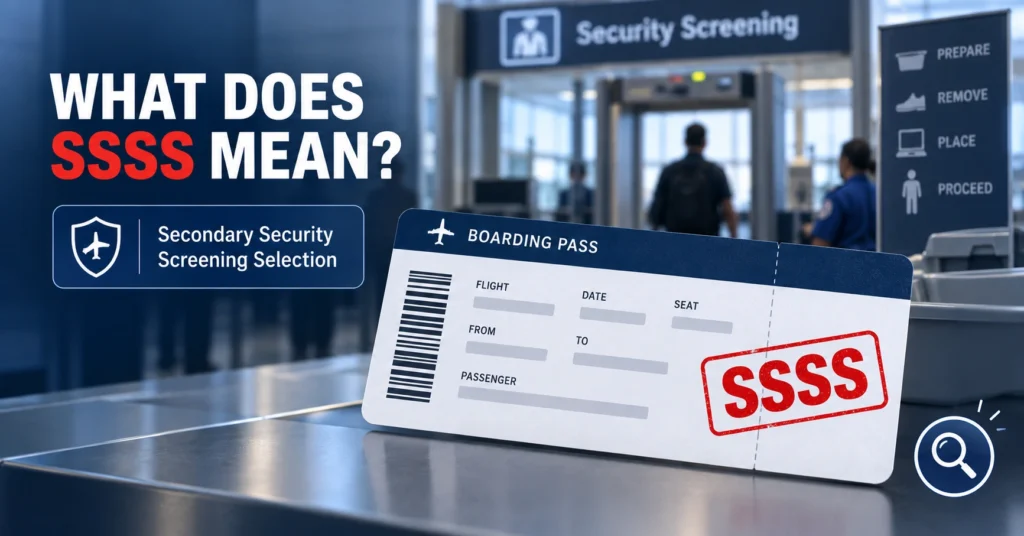
Spotting four capital S’s printed on your boarding pass is enough to make anyone’s stomach drop, especially if it’s your first time seeing it. Here’s the direct answer to what does SSSS mean on a boarding pass, along with what actually happens next and why you were selected in the first place.
The Direct Answer
SSSS stands for Secondary Security Screening Selection. It means you’ve been flagged by the TSA’s Secure Flight system for an additional, more thorough security check before you’re allowed to board, beyond the standard checkpoint screening every passenger goes through.
| Detail | Info |
|---|---|
| What it stands for | Secondary Security Screening Selection |
| Who decides it | TSA’s Secure Flight system, not the airline or gate agent |
| When it started | Introduced after the September 11 attacks |
| Applies to | Domestic and international flights to, from, or over the U.S. |
| Where it appears | Printed on the boarding pass, location varies by airline |
Why You Were Selected
Answering what does SSSS mean on a boarding pass only covers half the picture; knowing why it happens matters just as much. This is the part that frustrates people most, since neither the TSA nor airlines publish an exact list of criteria. That said, certain patterns are widely known to increase the odds of getting flagged.
| Common Trigger | Why It Raises a Flag |
|---|---|
| One-way ticket | Unusual travel pattern compared to standard round-trip bookings |
| Last-minute booking | Purchases made very close to departure draw extra scrutiny |
| Paying with cash | Less traceable than a credit card transaction |
| Flying into one city, departing from another | Breaks the typical round-trip pattern airlines and TSA systems expect |
| Travel to or from certain countries | Higher-risk routes under TSA’s risk-based screening model |
| Random selection | Sometimes it’s simply chance, with no identifiable pattern at all |
What Actually Happens After You’re Flagged
Once your boarding pass shows SSSS, you’ll typically be pulled aside either at the main security checkpoint or, on some international routes, right at the gate before boarding. The process is noticeably more involved than standard screening.
| Step | What to Expect |
|---|---|
| Body screening | Advanced imaging scan, often followed by a pat-down |
| Bag inspection | Carry-on items hand-searched, sometimes swabbed for explosive residue |
| Electronics check | You may be asked to power on devices to confirm they work |
| Questioning | Officers may ask about your itinerary or who packed your bags |
| Private screening option | You can request this, with a companion or witness present if you choose |
Can TSA PreCheck Save You From This?
Not entirely, and this surprises a lot of frequent flyers. Even travelers enrolled in TSA PreCheck or Global Entry can still receive an SSSS designation on a specific itinerary. When this happens, you won’t be able to use the PreCheck lane for that particular flight, regardless of your enrollment status, since the SSSS flag overrides the expedited screening benefit for that trip.
Does Every Airline Show It the Same Way?
Mostly, but not universally. Most carriers print “SSSS” directly in capital letters somewhere on the boarding pass, though the exact placement varies, sometimes in a corner, sometimes elsewhere on the document. Southwest Airlines is a notable exception, using a checkerboard pattern printed on the pass instead of the SSSS letters to indicate the same secondary screening selection.
A Few Practical Tips If You Get Flagged
Arrive at the airport earlier than you normally would, since the additional screening genuinely takes extra time and can catch travelers off guard if they’ve only budgeted for standard security wait times. Keep your electronic devices charged, since officers may ask you to power them on as part of the check. Packing neatly, with cords, powders, and dense items separated rather than jumbled together, tends to speed up the manual bag inspection. If you’re not able to generate a mobile boarding pass or get an error trying to check in online, that’s often an early sign you’ve been selected before you even reach the airport.
Common Questions About What SSSS Means on a Boarding Pass
It stands for Secondary Security Screening Selection, a TSA designation indicating you’ll undergo additional security checks beyond the standard checkpoint screening before boarding.
There’s no guaranteed way to remove it once assigned for a specific flight, though contacting your airline or TSA is sometimes suggested. Enrolling in TSA PreCheck or Global Entry may reduce future selection odds, but it doesn’t guarantee immunity.
Not necessarily. Selection can be random, or triggered by factors like booking patterns, one-way tickets, or destination, none of which imply wrongdoing on your part.
Usually not. Many travelers who experience it once, often on a first international trip or after an unusual booking pattern, never see it again on subsequent flights.
No. PreCheck and Global Entry members can still be selected for SSSS on a given itinerary, and if selected, they lose access to the expedited PreCheck lane for that specific flight.